
Forklifts are an important industrial tool, especially for organisations with warehouses.
These machines are used to lift, carry, and arrange goods efficiently in warehouses, construction sites, and so on. However, not every forklift is the same. They may vary based on their applications and the environment they are used in.
Knowing the types of forklifts and their purposes assists in selecting the appropriate one that fits your operations. We shall have a closer examination of the various types of forklifts and their application in the various industries.
Counterbalance Forklift
The most familiar and common one is the counterbalance forklift. It derives its name from the counterweight in the back, which balances the load lifted in the front. This design is simple and efficient and therefore can be used both indoors and outdoors.
Such forklifts are commonly found in factories, loading bays, and storage. They are ideal for activities such as loading trucks, moving pallets and transporting goods within a short distance. Electric models are popular in indoor applications, and diesel or gas types are popular in outdoor applications.
Reach Truck Forklift
The reach truck is a special forklift that is used in warehouses to store in high stacking and narrow aisles. It has extendable forks that can reach deep inside racks, and therefore operators can access goods that are several levels high.
This is an ideal type of forklift for the distribution centres and warehouses where space is minimal and shelves are high. Being designed primarily to be used indoors, it will work best on smooth surfaces.
Pallet Jack (Pallet Truck)
Pallet trucks or pallet jacks are the smallest and most basic types of forklifts. They are mostly used to transport pallets within a short distance. The pallet jacks do not have the capability of lifting the loads very high like other forklifts; they just have to raise the loads to a height that will allow them to transfer them to another location.
It comes in manual and electric models. Manual pallet jacks are mostly applied in small warehouses or retail areas, whereas electric pallet jacks are applied in large operations to move quickly. They are one of the most widely used material handling equipment due to their simplicity and low cost.
Walkie Stacker
A walkie stacker is used as an intermediary between a pallet jack and a conventional forklift. It is able to push heavy loads that are even greater than a pallet jack. However, it is small and simple to use. The operator is walking behind or beside the machine and operating the machine by controlling it with a handle or control arm.
Walkie stackers are well-suited to smaller warehouses or retail stores that require the ability to lift vertically without having to spend on a full-size forklift. They have an electric power and light frame, which makes them efficient in narrow aisles and light tasks.
Rough Terrain Forklift
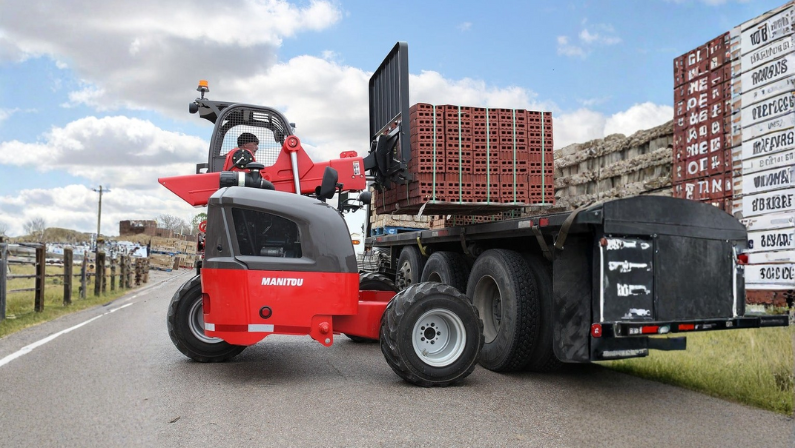
Forklifts are not designed to work on all smooth warehouse floors. The uneven ground, gravel, and outdoor building sites are the areas that the rough terrain forklift is designed to work with. It is fitted with huge air tyres and strong engines that give it good traction and stability in rough areas.
One can find these industrial forklifts in construction sites, lumber yards, and farms. They are used in the transportation of materials such as bricks, timber and steel. This kind of forklift is necessary in case your job involves lifting and moving on rough surfaces.
Telehandler Telescopic Handler.
The telescopic handler is a forklift that has the lifting capacity of a forklift and the reach of a crane. It has a boom arm that can be extended to move materials vertically and forward, hence it is very versatile.
This kind of forklift is usually found in construction, agriculture, and heavy industry. It is able to impose weights on roofs, carry materials to the higher levels or transport heavy items over a long distance.
Telehandlers may also be equipped with buckets, winches, or platforms, according to the task.
Side Loader Forklift
The side loader has the advantage of picking and carrying loads on the side instead of the front. It is a good design when dealing with long and bulky materials like pipes, timber or metal sheet.
Side loaders are commonly used in manufacturing plants, lumber yards and metal fabrication plants. They can transport long materials along the narrow aisles without turning, making them an asset to the industries that work with oversized products.
Order Picker Forklift
An order picker is a forklift specially designed to pick items in high storage racks found in the warehouse. It does not require lifting pallets, but rather lifts the operator to reach single items. These forklifts are an important component of e-commerce warehouses and large distribution centres where it is necessary to pick small objects in a short time and with high accuracy.
Order pickers are powered by electricity and are meant to work on smooth interiors.
Electric Forklift
Electric forklifts are gaining popularity because they are environmentally friendly and operate quietly. They run on rechargeable batteries and can be used in an indoor setting where emissions and noise should be reduced.
These forklifts come in various models, such as counterbalance and reach ones. Their clean energy consumption, reduced maintenance needs, and accuracy in handling make them a leading choice in the modern warehouse forklifts and logistics centres.
Industrial Forklift (Large Capacity Forklift)
The industrial forklift, also known as a heavy-duty forklift, is used to lift very heavy loads. It is a telehandler that has the stability of a counterbalance forklift.
These industrial forklifts are deployed in ports, manufacturing factories and heavy equipment warehouses. They are capable of moving objects that have a weight of several tons, including heavy machinery, shipping containers, or coils of metal. They have a strong frame and a strong engine that makes them important in demanding operations that require strength and reliability.
Conclusion
Forklifts are available in numerous shapes and sizes, and each type is suitable for different applications and environments.
Regardless of whether you are operating a warehouse, a construction site, or a manufacturing facility, choosing the right type of forklift will guarantee efficient operations and high productivity in the long run.


